


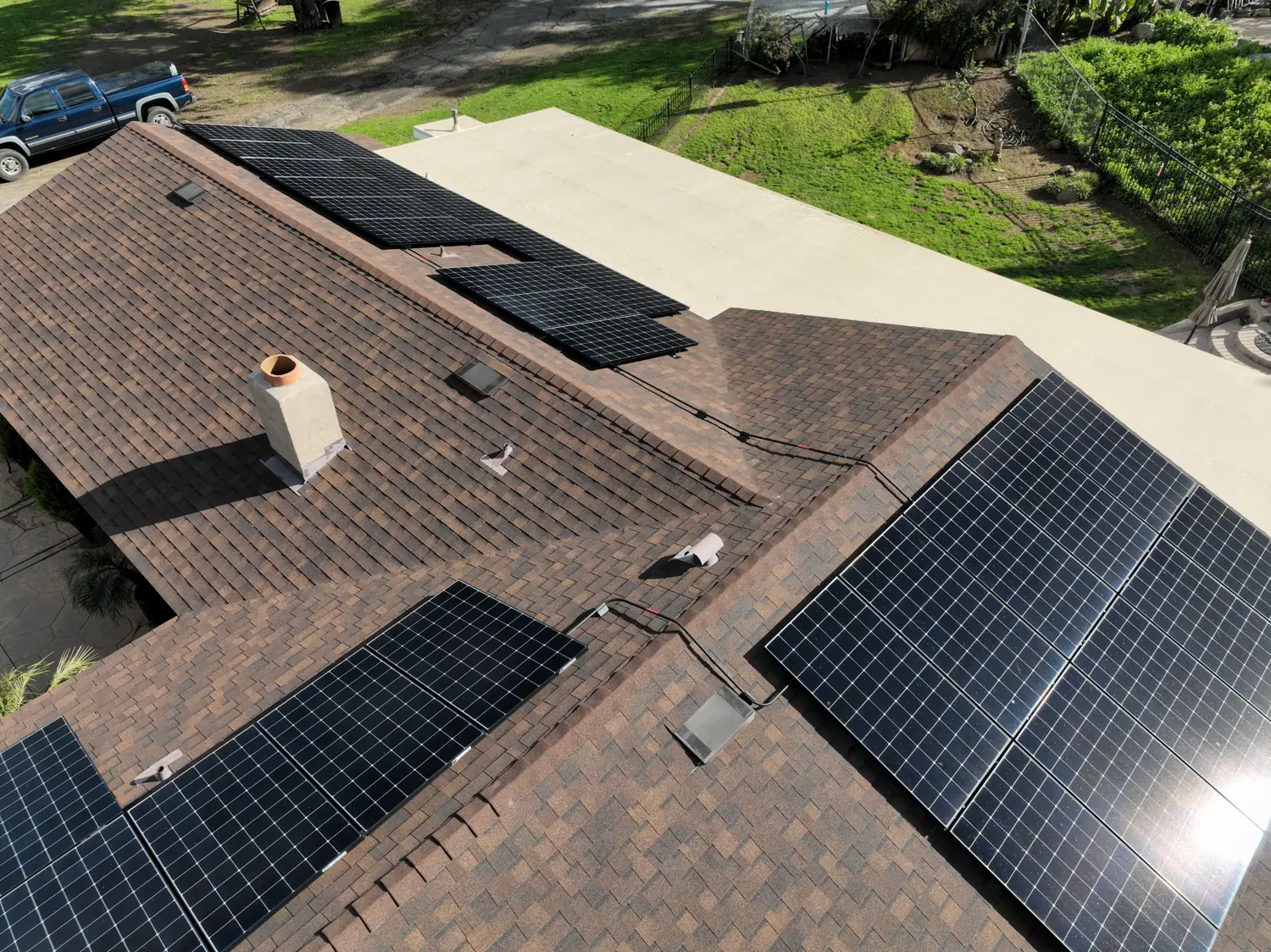
For most San Diego homeowners in 2026, paying cash delivers the lowest lifetime cost. A solar loan lets you own the system and capture tax incentives with little or nothing down. A lease or PPA makes sense if you can't use the federal tax credit, don't want maintenance responsibility, or plan to move within a few years.
What is the real difference between leasing, a loan and paying cash?
The core question is who owns the system. When you pay cash or use a loan, you own the panels and any battery from day one. Ownership is what qualifies you for incentives like the federal Investment Tax Credit (ITC), and it means every kilowatt-hour you produce works for you. When you lease or sign a power purchase agreement (PPA), a third-party company owns the equipment on your roof. You pay a fixed monthly amount (lease) or a rate per kilowatt-hour (PPA), and the owner keeps the tax benefits.
- Cash: you own it outright, pay nothing in interest, and keep all incentives.
- Loan: you own it, pay over time, and keep all incentives, but pay interest.
- Lease or PPA: a third party owns it, you pay monthly, and the owner keeps the incentives and handles upkeep.
How does NEM 3.0 change the math in San Diego?
California's NEM 3.0 billing rules pay you much less for the solar power you export to the grid than NEM 2.0 did. That means a solar-only system sends a lot of value back to SDG&E at a discount. The fix is pairing solar with battery storage, so you store your midday production and use it in the evening when rates are highest. Whichever payment method you choose, plan for a battery such as a Tesla Powerwall (about 13.5 kWh usable), Enphase IQ, Generac PWRcell, LG or sonnen. Check that your lease, loan or cash quote includes storage, or the savings estimate may be optimistic.
When does paying cash make the most sense?
Cash makes sense when you have the savings available, you plan to stay in your home for many years, and you have enough federal tax liability to use the ITC. You avoid interest entirely, so more of your utility savings stay in your pocket. You also own a clean asset with no lien or transfer paperwork if you sell your home.
- Lowest total cost over the life of the system.
- Full access to the 30% federal ITC, subject to eligibility (as of 2026, confirm the current figure and rules with your tax professional).
- Possible California SGIP battery rebates, with planning figures of roughly $200-250/kWh for the General tier, about $850/kWh for Equity and about $1,000/kWh for Equity Resiliency (as of 2026, confirm the current figure and program availability).
- No monthly payment once the system is installed.
The tradeoff is liquidity. Tying up a large sum in your roof means that money isn't available for other priorities, so weigh it against your emergency fund and other goals.
When is a solar loan the better choice?
A loan is the right fit for many San Diego homeowners who want ownership without a large upfront payment. You still own the system, so you can still pursue the ITC and SGIP, and your monthly loan payment is often designed to sit near or below what you were paying the utility. Once the loan is paid off, your solar production is essentially free power.
- Ask whether the loan assumes you'll apply your tax credit as a lump-sum paydown. If you don't, the payment may rise.
- Compare the interest rate and any dealer fees baked into the loan, not just the monthly payment.
- Confirm the loan term against the 25-year limited manufacturer warranty on the panels. Powersmith Energy is not the warranty provider; the manufacturer is.
- Understand how the lien works if you sell your home before the loan is paid off.
Who should consider a solar lease or PPA?
A lease or PPA can work if you don't owe enough federal tax to benefit from the ITC, you want a predictable payment with little or no money down, or you prefer that someone else own and monitor the equipment. Because the third-party owner claims the incentives, some of that value may show up as a lower monthly price for you. The main drawbacks are that you build no equity, your savings are usually smaller over the long run, and many agreements include annual payment escalators. When you sell your home, the buyer must qualify to take over the agreement, or you may need to buy it out.
- Read the escalator clause carefully and model what your payment looks like in year 10 and year 20.
- Ask what happens at the end of the term: renewal, buyout or removal.
- Confirm whether a battery is included and who controls how it operates under NEM 3.0.
Which option saves you the most money in San Diego?
In general, cash saves the most, a loan comes second, and a lease or PPA saves the least, but your actual numbers depend on your usage, roof, system design, battery choice and tax situation. Never pick an option based on a single monthly payment. Compare total cost over 25 years, factor in incentives you can realistically claim, and make sure every quote accounts for NEM 3.0 export rates. You can start with our free Solar Savings Calculator to estimate your production and bill offset, then review how the federal credit applies on our 30% federal ITC page.
How does Powersmith Energy help you choose?
Powersmith Energy is a veteran-owned energy consulting company and authorized dealer based in downtown San Diego, serving California and 16 states. We are not an installer. We partner with vetted top national and local installers, and we advocate for you from the first quote through the final inspection. That independence matters when you're choosing how to pay: we lay out lease, loan and cash options side by side so you can see the tradeoffs clearly. Review your options on our Financing page, or request a no-pressure comparison through Get a Free Quote.
Frequently asked questions
- Is it better to lease or buy solar in San Diego in 2026?
- Buying, with cash or a loan, usually saves more over the life of the system because you own it and can claim incentives like the federal ITC and California SGIP battery rebates. Leasing fits homeowners who can't use the tax credit, want no upfront cost, or may move soon.
- Can I get the 30% federal ITC if I lease solar?
- No. With a lease or PPA, the third-party owner claims the tax credit, not you. Only owners who pay cash or finance with a loan can claim it, subject to eligibility. As of 2026, confirm the current figure and rules with a tax professional.
- Do I need a battery with solar under NEM 3.0?
- Under California's NEM 3.0, exported solar is worth much less than under NEM 2.0, so pairing solar with storage such as a Tesla Powerwall, Enphase IQ, Generac PWRcell, LG or sonnen battery helps you use more of your own power and protect your savings.
- What happens to a solar lease or loan when I sell my house?
- With a loan, you typically pay off the balance at closing or as arranged with the lender. With a lease or PPA, the buyer usually must qualify to take over the agreement, or you may need to buy out the contract. A cash-purchased system simply transfers with the home.
- Does Powersmith Energy install solar systems?
- No. Powersmith Energy is a veteran-owned energy consulting company and authorized dealer in San Diego. We partner with vetted national and local installers and advocate for you throughout the project.